
Food Tech
Bee-Free Honey Hits Shelves as Synthetic Sweetener Tech Matures
Cellular agriculture and precision fermentation are poised to disrupt the honey market, offering identical products with distinct supply chain advantages.
By FTF Editorial Team·July 6, 2026·5 min read
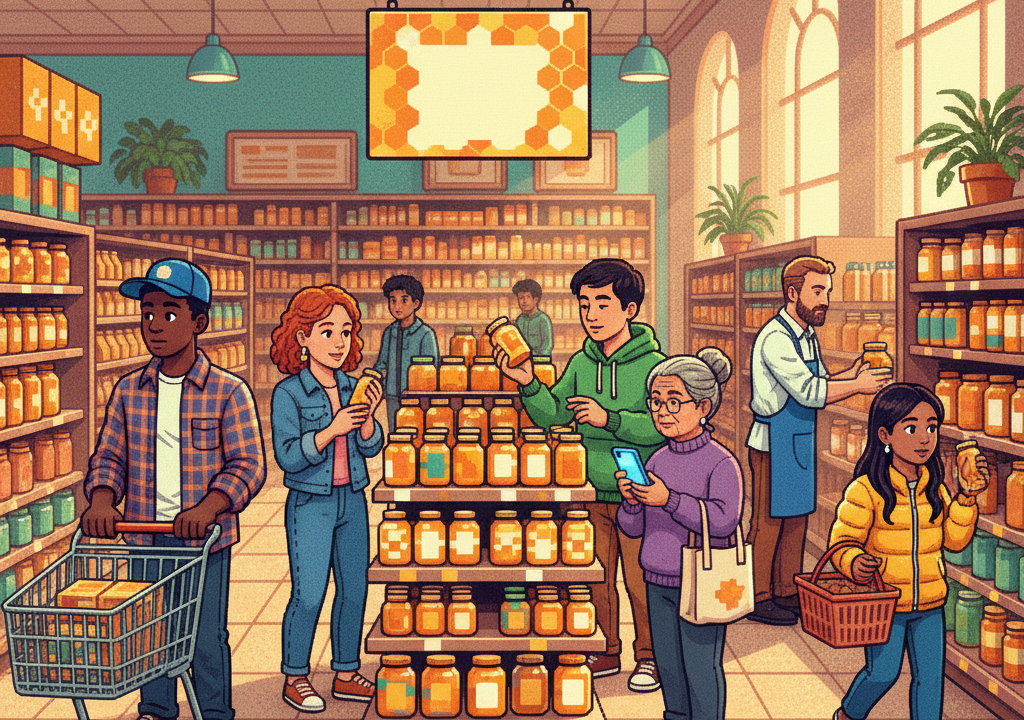
Bee-free honey, produced through advanced synthetic biology, is set to enter retail channels by 2026. This development promises supply chain resilience and addresses pollinator conservation concerns, but faces significant challenges in taste parity, cost, and consumer acceptance.
What happened

The nascent bee-free honey sector is transitioning from R&D to commercialization, with several startups targeting retail shelves in 2026. Companies such as NectarWorks Labs and Apisynthesis Foods are leveraging precision fermentation and cellular agriculture to produce molecularly identical honey without relying on bees. This process typically involves engineering microorganisms (like yeast or fungi) to produce specific proteins, enzymes, and sugar profiles found in natural honey, replicating its complex chemical composition.
The core technological advancement lies in precisely mimicking the hundreds of volatile organic compounds, enzymes, and sugars (fructose, glucose, maltose, sucrose) that contribute to honey's distinct flavor, aroma, and functional properties. Early prototypes have focused on replicating common varietals like clover and acacia honey, which have well-understood chemical signatures. While initial batches have been in controlled pilot programs, the scaling of bioreactor capacity and downstream processing is now reaching a point where significant commercial volumes are feasible.
These companies are pitching their products not only as sustainable alternatives but also as a solution to increasing supply chain volatility in the traditional honey market, which is susceptible to climate change, disease (e.g., Varroa mites), and agricultural pesticide use impacting bee populations. The promise is a consistent, high-quality honey product with a predictable supply, regardless of environmental factors.
Why it matters

The introduction of bee-free honey represents a significant inflection point for both the food industry and agricultural technology. For manufacturers, it offers a stable, scalable, and potentially more cost-effective ingredient source, mitigating risks associated with conventional honey procurement. This could lead to new product innovations in baking, confectionery, and beverage sectors, where consistent ingredient profiles are critical.
Beyond supply chain stability, the environmental and ethical implications are substantial. By removing the reliance on bee populations, these products address growing consumer and regulatory concerns about pollinator health and biodiversity. It also opens avenues for plant-based and vegan product lines to include 'honey' without compromise. However, achieving taste parity with natural honey, particularly the nuanced flavors of varietal honeies, remains a key challenge for broader market acceptance and will dictate the extent of its penetration into premium segments.
Market impact

Initial market entry is expected to target the ingredient sector for food manufacturers, followed by direct-to-consumer retail. Pricing will be a critical determinant of adoption; while early production may be premium-priced, economies of scale are projected to bring costs down, potentially undercutting conventional honey in the long term. This could create a bifurcated market: premium natural honey coexisting with a more affordable, consistent, and sustainable synthetic alternative. The honey industry will need to differentiate or risk market share erosion.
Consumer insight

Consumer perception will be pivotal. While 'sustainable' and 'eco-friendly' messaging resonates, the term 'synthetic' or 'lab-grown' can evoke skepticism. Successful market penetration will rely on transparent communication about the bio-identical nature of the product and its environmental benefits, rather than framing it as a 'fake' alternative. Education on precision fermentation as a natural process (using microbes) will be crucial to overcome potential aversion.
Strategic takeaway

Food manufacturers and retailers should actively track the development and cost curve of bee-free honey. Pilot testing in R&D for ingredient applications is advisable to assess functional performance and consumer acceptance. Early partnerships with leading producers can secure preferential supply and competitive positioning as this new category matures.
Get the next signal in your inbox.
Daily food industry intelligence — free.
You've reached the end.