Food Tech
The Bowl Bots Are Winning the Lunch Rush
Precision portioning and the rise of the 'Infinite Kitchen' are redefining the lunch rush.
By FTF Editorial Team·June 2, 2026·3 min read
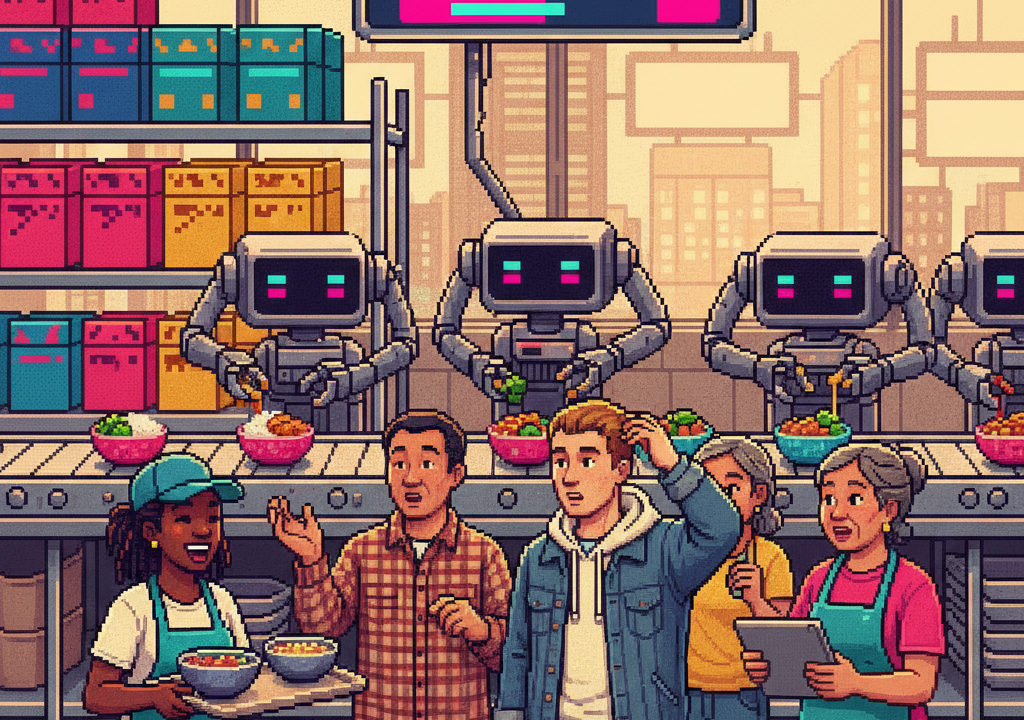
Back-of-house automation has reached a tipping point, as major chains deploy modular robotic assembly lines to solve persistent labor shortages and ensure portion precision.
What happened

In the second quarter of 2026, Sweetgreen announced the conversion of its 50th 'Infinite Kitchen' location, citing a significant reduction in ticket times to under four minutes during peak hours. Simultaneously, Chipotle Mexican Grill expanded its partnership with Hyphen, deploying the 'Cobot' automated digital makeline to 120 high-volume suburban units. These systems utilize a subterranean or overhead rail mechanism to dispense ingredients with sub-gram accuracy, while human staff focus on final garnishes and customer hospitality. This shift follows Recent NSF certifications for three new robotic dispensers from startups like Dexai Robotics, facilitating faster nationwide rollouts.
Why it matters

The scaling of robotic assembly addresses the 'triple threat' facing 2026 foodservice: persistent labor volatility, soaring ingredient costs, and consumer demand for hyper-customization. By eliminating 'portion creep', accidental over-serving of expensive proteins like steak or avocado, chains can reclaim up to 3% of their COGS. Furthermore, the decoupling of the digital make-line from the physical walk-up line allows restaurants to double their throughput without increasing their real estate footprint.
Market impact

The automated foodservice equipment sector is projected to grow at a CAGR of 16.4% through 2028. Following Chipotle's $45M investment in Autocado and Hyphen, the market has seen a surge in competitive deployments. Sweetgreen’s Infinite Kitchen locations are reporting 20% higher throughput and 500-basis-point margin improvements compared to legacy builds, prompting regional players like Chopt and CAVA to accelerate their own proprietary 'smart-line' pilots in high-rent urban corridors.
Consumer insight

Despite initial skepticism regarding 'soulless' automation, consumers in 2026 prioritize consistency and customization over human interaction in high-speed lunch environments. Patrons report higher satisfaction scores for 'perfectly dressed' salads where dressing-to-leaf ratios are calibrated by sensors. This 'functional transparency' (seeing the machine work behind glass) has turned assembly lines into a form of industrial theater, satisfying a desire for both food safety assurance and high-tech entertainment.
Strategic takeaway

Operators should prioritize 'modular' automation that integrates with existing POS systems rather than total kitchen overhauls. The goal for 2026 is 'Co-botting': using machines for repetitive, high-volume assembly tasks while reallocating human labor to 'front-of-house hospitality' and complex prep work that machines still struggle to execute.
Get the next signal in your inbox.
Daily food industry intelligence — free.
You've reached the end.